

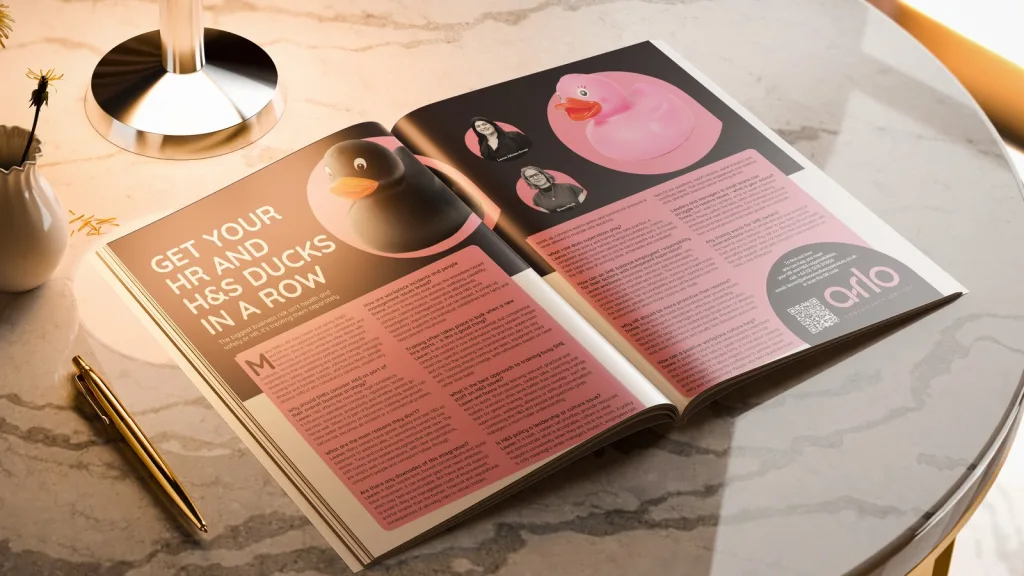
By Lauren Johnson Arnott, Managing Director & Founder, arlo consultancy services. As featured in the Autumn 2026 edition of Your Business with James Caan.
When I started arlo consultancy services, one of the things I felt strongly about was that businesses needed a different approach to HR, Health & Safety and compliance.
Not necessarily more policies, more paperwork or more complicated systems. But practical, joined-up support that genuinely understands how a business operates and, more importantly, the people within it.
Having recently contributed to Your Business with James Caan, alongside our People Director, Donna North, it was a great opportunity to explore something I believe is often overlooked, particularly within growing businesses.
HR and Health & Safety are frequently treated as two entirely separate functions, when in reality, they are far more connected than many organisations realise.
And I think that’s where businesses can miss some of their biggest opportunities to improve.
Two Functions, One Business
Traditionally, Health & Safety has been viewed as the function responsible for preventing accidents, managing risks and ensuring legal compliance.
HR, meanwhile, has focused on recruitment, contracts, employee relations, performance and wellbeing.
Of course, both have their own specialist responsibilities, and rightly so.
But think about what happens when something goes wrong.
An employee has an accident at work. Is that purely a Health & Safety issue?
What if the employee hadn’t received adequate training? What if their supervisor wasn’t confident in managing the task? What if concerns had previously been raised but never properly addressed? What if workload pressures or poor communication contributed to the incident?
Suddenly, we’re looking at far more than a risk assessment or an accident report.
We’re looking at leadership, competence, communication, employee wellbeing, management accountability and workplace culture.
These aren’t separate business challenges. They’re interconnected parts of how an organisation operates.
And when HR and Health & Safety work independently, there is a real risk that important information, patterns and opportunities for improvement are missed.
Compliance Should Support Your Business, Not Complicate It
One of the things I see regularly when working with businesses is that compliance can become something organisations feel they have to manage around their day-to-day operations.
Policies are written, risk assessments are completed, training records are filed and procedures are introduced.
But the question I always come back to is:
Does any of it actually work in practice?
Do employees understand what’s expected of them?
Do managers have the knowledge and confidence to make the right decisions?
Are people comfortable raising concerns?
And when something isn’t working, does the business recognise it early enough to do something about it?
Because a beautifully written policy means very little if the people responsible for implementing it don’t understand it, believe in it or have the support to put it into practice.
Good compliance should create clarity, not confusion.
It should help businesses operate more effectively, protect their people and make better decisions.
That is where I believe HR and Health & Safety can make a real difference when they work together.
Investing in People Is Investing in Your Business
Another area I discussed within the magazine was the importance of training and competent supervision.
And for me, this is fundamental.
Training shouldn’t simply be something we deliver because a certificate is due to expire or because somebody has joined the business.
Training should give people the knowledge, skills and confidence to carry out their roles safely and effectively.
A structured induction is important, but it’s only the beginning.
People need role-specific training, opportunities to apply what they’ve learnt, ongoing support and supervision that reflects the risks and responsibilities of their work.
And this applies just as much to managers as it does to frontline employees.
We often promote people because they’re technically good at what they do, but that doesn’t automatically mean they’re equipped to manage people, recognise concerns, have difficult conversations or make decisions involving safety and wellbeing.
Those are skills that need to be developed.
I genuinely believe that investing in managers and supervisors is one of the most valuable things a business can do.
Because competent supervision isn’t about catching people doing something wrong.
It’s about recognising when someone needs support, identifying issues before they escalate and creating an environment where people understand what good looks like.
When we get that right, the benefits extend far beyond compliance.
We see better communication, stronger teams, improved performance and, ultimately, safer and more positive workplaces.
Culture Isn’t What You Write in a Policy
Workplace culture is something we talk about constantly across HR and Health & Safety.
But culture isn’t created by writing a statement about company values or displaying a poster in the office.
Culture is what happens when leadership isn’t in the room.
It’s how managers respond when somebody raises a concern.
It’s whether employees feel comfortable admitting they’ve made a mistake.
It’s how consistently expectations are communicated and whether people believe they’ll be treated fairly.
And it’s whether the business genuinely acts on the things it says are important.
You cannot build a positive safety culture without considering the people-management side of the business.
Equally, you cannot create a genuinely supportive workplace without recognising the importance of safe working conditions, clear responsibilities and effective risk management.
The two have to work together.
Donna and I explored this throughout our discussion, particularly around the value of proactive HR and the importance of addressing concerns before they become formal issues.
For me, the same principle applies across Health & Safety.
Prevention will almost always be better than reaction.
But prevention requires businesses to listen, communicate, recognise patterns and be prepared to act.
The Challenges of Growing a Business
As a business owner myself, I understand that growing a company brings competing priorities.
You’re focused on delivering for clients, developing your team, managing costs, recruiting the right people and planning for what’s next.
And sometimes, HR and Health & Safety can feel like another responsibility competing for attention.
But I believe this is precisely why they need to form part of your wider business strategy.
As businesses grow, informal arrangements that worked when there were five employees don’t necessarily work when there are 20, 50 or 100.
Responsibilities change. Teams develop. Managers take on more accountability. Risks become more complex.
And without the right foundations, gaps can start to appear.
This doesn’t mean every growing business needs a large internal HR department or a dedicated Health & Safety team.
It means having access to the right expertise, developing competent people and introducing proportionate systems that grow alongside the organisation.
Sometimes that involves significant change.
But often, it’s about getting the fundamentals right.
Clear responsibilities. Effective communication. Practical training. Competent supervision. Consistent processes.
And ensuring the people responsible for delivering them have the support they need.
Why We Take a Joined-Up Approach at arlo
One of the reasons we’ve developed arlo around HR, Health & Safety, Environmental and Quality consultancy is because we recognise how closely these areas influence one another.
Our clients don’t operate in separate departments when they’re making day-to-day business decisions.
They’re managing people, delivering services, balancing commercial pressures, meeting legal responsibilities and trying to build successful businesses.
So why should the support they receive be disconnected?
Our approach has always been about understanding the bigger picture.
Not just identifying what a business needs to comply with, but understanding how those requirements can be implemented practically and sustainably.
That might mean supporting managers with competence and supervision, improving reporting and communication, aligning HR processes with operational responsibilities or helping leadership teams understand the risks and opportunities across their organisation.
It isn’t about making things more complicated.
It’s about making things work together.
And importantly, it’s about recognising that every business is different.
My Message to Business Owners
If there’s one thing I’d encourage business owners and leaders to consider, it’s this:
Don’t wait for something to go wrong before you look at how your people, safety and management arrangements work together.
Ask yourself whether your managers feel confident in their responsibilities.
Whether employees have the training and support they need.
Whether concerns are being raised and acted upon.
And whether your HR and Health & Safety arrangements are genuinely helping your business move forward.
You don’t need to change everything overnight.
Sometimes, the most meaningful improvements start with a conversation, a clearer process or giving someone the right support.
But those small, consistent improvements can make a significant difference over time.
Because ultimately, good HR and Health & Safety aren’t just about meeting legal requirements.
They’re about protecting people, building confidence, strengthening businesses and creating environments where people can do their best work.
And I believe that’s something every business should be working towards.
Read Our Feature in Your Business with James Caan
I was delighted to contribute to the Autumn 2026 edition of Your Business with James Caan, sharing my views on investing in people, training and competent supervision, alongside a wider discussion with Donna North about integrating HR and Health & Safety.
You can find our contributions on page 178 and pages 458–459.
Read the Autumn 2026 edition of Your Business with James Caan.
If you’d like to talk about how your HR and Health & Safety arrangements could work better together, get in touch with the team.